We live in a world that constantly tells us more is better: more products, more content, more choices, more stimulation. For many people, this is background noise. But for those of us who are highly sensitive (HSPs) or neurodivergent, including those with ADHD, autism, anxiety, or sensory processing differences, overconsumption doesn’t just clutter our homes. It clutters our nervous systems.
This post is a gentle look at what overconsumption actually does to us, and how to recognize when we’ve quietly crossed the line from “enough” into “too much.”
“It’s not just about stuff. It’s about how much our minds and bodies are asked to process every single day.”
What Is Overconsumption, Really?
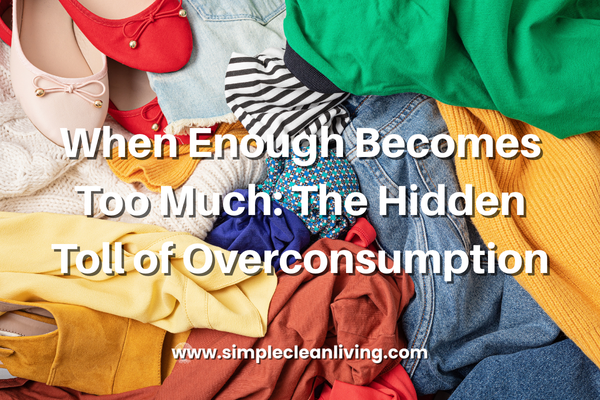
Most conversations about overconsumption focus on physical things…buying too many clothes, accumulating too much furniture, filling our homes beyond what we need. And while that’s certainly part of it, overconsumption goes much deeper for sensitive and neurodivergent individuals.
Overconsumption can look like:
- Digital consumption — scrolling endlessly, consuming news, videos, podcasts, and social media beyond what genuinely nourishes us
- Social consumption — over-scheduling, over-committing, saying yes when our whole body is saying no
- Sensory consumption — too much noise, too many visual inputs, overstimulating environments
- Information consumption — research rabbit holes, decision fatigue from too many options, constant mental “intake.”
- Material consumption — shopping as coping, accumulating things that add visual and logistical clutter
For highly sensitive people, each of these categories carries a higher cost than it might for others. Our nervous systems are quite literally processing more. That means overconsumption doesn’t just feel inconvenient; it can feel genuinely destabilizing.
The Real Impacts of Overconsuming
On your nervous system
The nervous system of a highly sensitive or neurodivergent person is already working harder than that of the average person. When we layer on excess stimulation, we push that system toward chronic overdrive. This can manifest as persistent anxiety, difficulty winding down, trouble sleeping, or that worn-out-but-wired feeling at the end of the day where your body is exhausted but your mind simply won’t quiet.
On your mental clarity and focus
Every object in your visual field, every notification, every unread email, every half-finished project competes for a small piece of your attention. For those with ADHD or sensory sensitivities, this isn’t a metaphor; it’s an actual cognitive load. Overconsumption fragments focus, increases decision fatigue, and can make even simple tasks feel overwhelming when the environment is cluttered and overstimulating.
On your emotional well-being
There’s a quiet grief that comes with owning too much. The guilt of items unused, the anxiety of debt or disorder, the longing for spaciousness that never quite arrives. Overconsumption, particularly of social media and comparison-driven content, can quietly erode self-worth, leaving us chasing a sense of “enough” through more accumulation. For sensitive people who tend to internalize deeply, this cycle can be particularly painful.
On your physical body
Chronic overstimulation keeps the body in a low-grade stress response. Over time, this contributes to tension, headaches, disrupted digestion, immune dysregulation, and profound exhaustion. The body keeps the score of everything the mind absorbs, and the sensitive body absorbs a great deal.
On your relationships and sense of self
When we’re overwhelmed by too much, we often have less to give…to the people we love, and to ourselves. Overconsumption can crowd out the quiet time that sensitive and neurodivergent people need to restore, reflect, and simply be. Without that space, we can lose touch with who we actually are beneath all the noise.
12 Signs You May Be Overconsuming
These signs are not a checklist to shame yourself with. They’re gentle mirrors…invitations to notice and reflect. Many of us will recognize several of these, especially during stressful seasons of life.
1. You feel exhausted but can’t explain why
You haven’t done anything physically demanding, yet you’re depleted. This is often sensory and cognitive overload. Your system is working overtime processing everything it’s taken in.
2. Your home or workspace feels visually noisy
You walk into a room and feel a low-level hum of tension. Clutter, even organized clutter, creates ongoing sensory input that sensitive nervous systems must continually manage.
3. You scroll out of habit, not enjoyment
You pick up your phone without meaning to. And you find that you finish a scroll session feeling vaguely worse, not better. The consumption is automatic, not intentional.
4. Shopping feels soothing in the moment but hollow afterward
Retail therapy brings brief relief, but the item arrives, and the feeling is flat. This cycle, seeking comfort through acquiring, is a hallmark of consumption used as emotional regulation.
5. You have persistent decision fatigue
Too many options, in your wardrobe, in your schedule, in your pantry, online, leave you feeling paralyzed or irritable. More choices do not equal more freedom for sensitive minds.
6. You have trouble sitting in quiet
Silence feels uncomfortable. You reach for a podcast, a show, or your phone to fill the space. If stillness has become hard to tolerate, it may be a sign your system has adapted to constant stimulation.
7. You feel guilt or anxiety about your belongings
Items pile up that you haven’t used, don’t love, or feel obligated to keep. This background guilt is a genuine emotional weight…one that accumulates alongside the objects themselves.
8. Your calendar leaves no breathing room
Every hour is filled. Rest is something you intend to “get to.” Social or logistical commitments leave no space for unstructured recovery, which sensitive and neurodivergent people need more of, not less.
9. You start many things but finish few
Too many subscriptions, hobbies, projects, or purchases begun and abandoned. This is often a sign that consumption is being used to seek stimulation or novelty rather than genuine engagement.
10. You feel disconnected from what you actually enjoy
When asked what you like to do, it’s hard to answer. So much consumption has happened that the quieter signal of genuine personal preference has been drowned out.
11. You’re often comparing yourself to others online
Social media consumption, when it becomes compulsive, tends to fuel comparison. For sensitive people who absorb others’ emotions and standards deeply, this can subtly undermine self-acceptance.
12. You long for simplicity but don’t know where to start
There’s a persistent, quiet ache for less…fewer things, fewer obligations, fewer tabs open in life and literally on your screen. That longing is meaningful. It’s your nervous system asking for space.
So What Now?
Simply recognizing these patterns is genuinely significant. Many of us have spent years not understanding why we felt so overwhelmed when, on paper, our lives seemed fine. Understanding that overconsumption, in all its forms, has a real and measurable cost on sensitive nervous systems changes the conversation from “what’s wrong with me?” to “what does my system actually need?”
I’ll be exploring simple, sustainable ways to begin reducing overconsumption in future posts…always through the lens of gentleness, not deprivation. Because simplicity isn’t about living with less for its own sake. It’s about creating the kind of space where your real life, the one that fits you, can finally breathe.