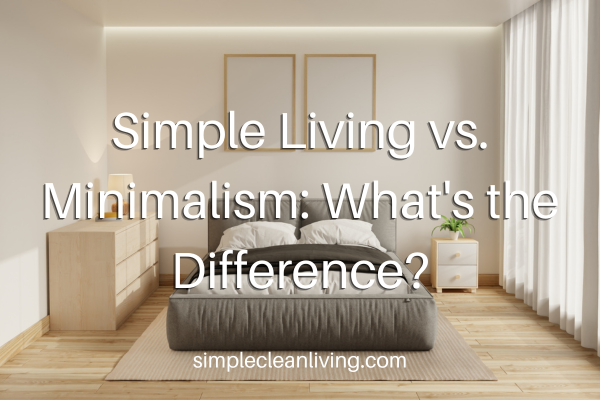
You’ve likely seen the term “minimalism” used all over social media. But what does that even mean? It typically means white rooms that are pristine, empty shelves, and people who own capsule wardrobes with exactly 33 items of clothing. And what about the phrase “simple living”? That sounds pretty similar. But are they the same thing? Well, not exactly. Both ideas are about cutting back on the chaos and material things of modern life. But they go about it in different ways.
Okay, let’s break it down a bit…
What is minimalism?
Minimalism as a lifestyle focuses on owning as few things as possible. The idea behind minimalism is that owning too much stuff weighs you down, mentally, emotionally, and financially. If you own less, there is less to clean and less to worry about. And of course, with less “stuff” there will always be less clutter taking up space in your home…and your mind.
People who live a minimalist lifestyle are picky about their possessions. Quality is more important than quantity, and they are very intentional about what comes into their homes. Some of them choose to have a capsule wardrobe. A capsule wardrobe includes a small number of individual items that all mix and match. Others opt to live in tiny houses or even go “off the grid” using solar energy and well water.
The basic idea of minimalism is intentionally removing things from your life.
What is simple living?
Simple living doesn’t focus so much on how many things you own. It is more about slowing down and focusing on what is truly important to you. People who choose to live simply want their everyday life to feel calm, instead of rushed or overwhelming.
Living simply is the way I’ve chosen to live. For me, simple living looks like cooking homemade meals from scratch, spending plenty of time in nature, cutting back on screen time, growing a garden, and choosing a slower-paced job over a high-stress one. It’s about stepping away from hustle culture and asking, “What do I actually need to be happy?”
Someone who practices simple living might have a cozy, full home that includes books stacked on shelves, kids’ art on the walls, and a well-worn kitchen table. Their life doesn’t look empty or minimal. It’s just intentional.
Where do they overlap?
Both lifestyles challenge the idea that having more stuff, making more money, and always being busy automatically make life better. Both lifestyles encourage you to be intentional. They are both about making choices on purpose, instead of just following the crowd.
There are a lot of people who practice a little of both lifestyles. For example, you might declutter your closet like a minimalist. And you also may choose to cook at home more and spend less time on social media, which is more about living simply. No rule says you have to pick one.
Which one is right for you?
Are you drawn to clean spaces? Do you get stressed by clutter, and like the idea of owning only what you truly love? Minimalism might work well for you.
Are you more focused on having more time (time to read, garden, rest, connect with family, or pursue hobbies)? Simple living might be better for you.
Honestly? The two go well together for a lot of people. You don’t need to be a “perfect minimalist” with an all-white apartment to benefit from owning a little less. And you don’t need to move to the country to live more simply.
A few questions to get you started
So what happens if you’re not sure where to begin? Ask yourself these questions:
- What areas of my life feel like “too much” right now?
- Am I more stressed by clutter or by a packed schedule?
- What would I do with an extra hour each day?
- What do I keep buying that I don’t actually use or need?
Your answers can help to point you in the right direction. Whether you go full minimalist, lean into simple living, or mix both, the real win is becoming more thoughtful about how you spend your time, money, and energy.